View Transcript
0:00
At Columbia Gas of Ohio, we understand that many families are already making difficult decisions about household expenses.
0:07
That's why, as we prepare to request a rate adjustment this October, we want to be direct about why it's necessary and what it means for our customers.
0:17
Every day, we serve approximately 1.5 million customers across 61 Ohio counties through more than 20,000 miles of natural gas pipeline.
0:26
Keeping that system safe and reliable requires ongoing investment to replace aging infrastructure, improve system monitoring, and provide our crews with the tools and technology they need to serve you.
0:38
We work hard to balance reliable service with responsible cost management.
0:43
Over time, costs have risen gradually at a rate below inflation.
0:47
Gas continues to be a low cost energy source compared to other alternatives.
0:51
I encourage you to explore the information on this page to learn more about the rate case, customer benefits, and available assistance programs.
1:01
As we continue to invest in the future of our energy system, I'll leave you with our ongoing commitment to serve you reliably, safely, and responsibly.
Like many essential services, the cost of maintaining safe and reliable natural gas service has increased. Columbia Gas is requesting a rate adjustment to continue modernizing pipelines, strengthening system reliability and upgrading technology to ensure we are serving our customers' homes and businesses every day. The rate change would impact January 2028 bills.
Customer Benefits
Customers receive several benefits from Columbia’s investments in its system:- Safer infrastructure by replacing older pipelines and equipment
- More reliable service during extreme weather
- Fewer outages and faster emergency response through modern monitoring systems
- Modern, supported customer systems that provide clear information, simple support options and consistent service across platforms
- Expanded service to businesses that bring jobs to our communities and spread the costs of utility service across more customers
Click to see how the rate case process works
How the rate case process works
As a regulated utility, Columbia Gas can’t change natural gas rates without approval. Here’s how the process works:
- We submit a proposal to the Public Utilities Commission of Ohio (PUCO) explaining why a rate change is needed, including details about investments, costs and customer bill impacts.
- The PUCO conducts a thorough review of the proposal and considers input from a variety of stakeholders. This review process includes expert analysis and input from customers, consumer advocates, and other stakeholders, as well as a formal court-like proceeding.
- A decision is made by the PUCO after up to a year of review. After the decision is made, the approved rates will go into effect on a specified date.
Columbia’s filing can be found on the PUCO's website here.
To request a hard copy of Columbia's Tariff Sheets and its Typical Bill Comparison, please email Legal Department and please specify how you would like the documents (i.e., hard copy, USB flash drive, or compact disc).
Current tariff
The Public Utilities Commission of Ohio (PUCO) approves rules and regulations that govern the operations and rates of Columbia Gas of Ohio.
Frequently Asked Questions
Why is a rate increase necessary?
The rate increase allows Columbia Gas to recover the cost of investments we’ve made, and will continue to make, in our natural gas system. These investments help ensure we can serve our customers.
Adjusting rates through this regulatory process helps ensure our cost recovery and profits remain fair, transparent and predictable so we can continue providing safe, efficient and reliable service to our customers.
Thank you for your response.
What specifically does Columbia invest in?
Our top priority is providing safe and reliable natural gas service to our customers. To do that, we must continue investing in our system. These investments include replacing older pipes and meters with newer equipment and upgrading technology so the system functions properly.
- Modern equipment helps prevent outages and keeps natural gas flowing safely. It also allows us to meet important federal safety requirements that protect customers, communities and the environment.
- Expanding our system to serve new areas brings in new customers, which helps spread the fixed costs of operating the system across more people. This helps alleviate how much of those costs are passed on to individual customers.
- System investments support the local employees who operate, maintain and respond to issues on our system.
Thank you for your response.
When will the new rates go into effect?
The newly adopted Ohio legislation (Senate Bill 103) allows utilities to set rates for a three-year period. This creates stability and certainty for customer delivery charges over a period of time. Columbia's proposal will set rates for Calendar Year 2028, 2029 and 2030.
Thank you for your response.
How will the rate increase impact a customer’s bill?
When the proposed rate adjustment takes effect at the start of 2028, it will be no more than a 7-8% increase compared to what an average residential customer would have otherwise been paying in that year. In years two and three of the rate plan, Columbia projects the average residential customer bill will increase approximately 4.6% and 3.8%, respectively.
Thank you for your response.
Why is the increase higher in the first year of the plan?
Under new bipartisan legislation, Columbia Gas is moving from rates that recover costs already incurred to rates based on the budget for the upcoming year. This change creates a one-time transition where two years of costs – 2027 and 2028 – will be included in the new rates for 2028. Thereafter, as before, each year’s rates will be adjusted to recover a single year of budgeted costs.
Thank you for your response.
Does the change to a three-year plan support lower costs?
Yes, over time the new three-year plan should reduce the amount of finance charges passed on to customers. When Columbia makes an investment, it eventually collects those costs from customers. Part of this recovery includes compensating Columbia for borrowing the money for the investment. The longer the period between investment and recovery, the higher this financing amount becomes. The new forecasted rate plan recovers costs closer to when Columbia makes investments, therefore significantly reducing these financing costs for customers.
A shorter recovery time creates a stronger utility, which ultimately costs customers less. When we borrow money to make system investments, we pay interest – similar to how people pay interest on credit cards or loans. Just like those with higher credit scores get lower interest rates, a utility that maintains strong financial health, qualifies for lower borrowing costs. Lower borrowing costs mean we pay less to finance projects, and those savings directly reduce the amount customers are charged.
Additionally, the new three-year plan will support continued investments in Ohio to support economic growth. As more customers connect to the system overall usage grows, and fixed system costs can be spread across a broader base, helping reduce costs for individual customers.
Thank you for your response.
What other changes should customers expect to see on their bills?
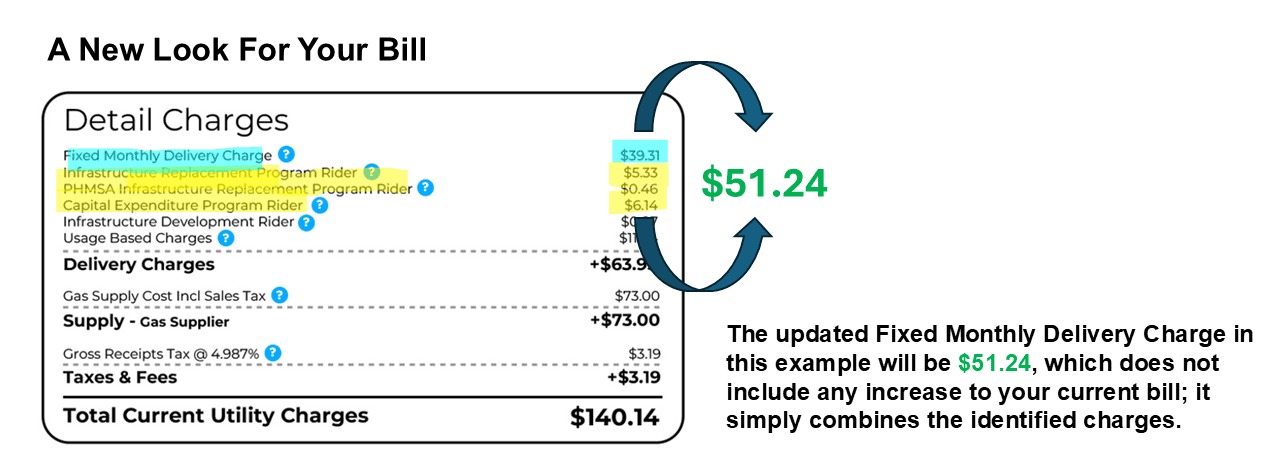
As a result of the new legislation, three riders (charges that cover the cost of programs and projects that aren’t included in the base charge) that normally appear on your bill are now going to be included in your Fixed Monthly Delivery Charge, established through this rate case. This new legislative requirement will simplify customer bills to make them more understandable.
The three riders that will be rolled into the Fixed Monthly Delivery Charge include the following:
- Infrastructure Replacement Program Rider – recovers the cost of replacing aging pipelines before they leak and create potential safety issues. Proactively replacing these pipelines before problems occur helps enhance safety, improve reliability and reduce the risk of outages.
- PHMSA Infrastructure Replacement Program Rider – recovers costs associated with requirements adopted by the Pipeline and Hazardous Materials Safety Administration which has authority over pipeline safety.
- Capital Expenditure Program Rider – This work generally improves the reliability of the system by making smart investments to increase the amount of gas that can be moved through our pipes, expanding service to new customers to spread our costs over more customers, investing in information technology which include important investments in cybersecurity, and investing in safety to meet our federally-mandated safety plans.
These costs are not new and they do not increase because of the consolidation. They move from one part of the bill to another. A customer comparing an old bill to a new one will see a larger fixed charge and fewer line items below it, reflecting the same underlying costs.
Thank you for your response.
What is the difference between supply and delivery charges?
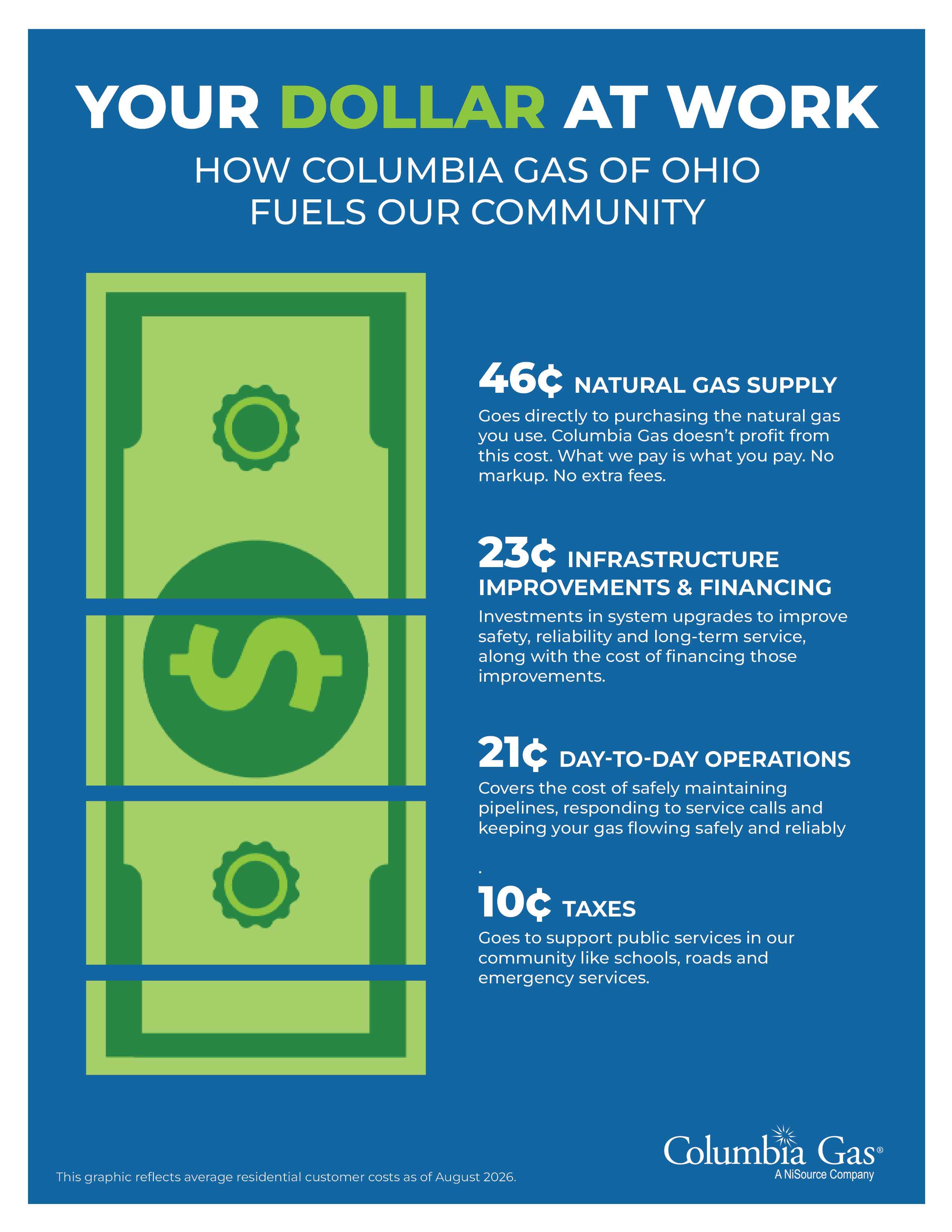
Delivery (Distribution) Charges are the cost of bringing the gas to your home. This includes a basic customer fee and the cost of operating and maintaining the natural gas pipelines and other parts of the system that safely and reliably deliver natural gas to your home so it’s available when you need it most.
Both the Gas Supply Charge and a few small parts of the Delivery (Distribution) Charge change depending on how much gas you use. When it’s cold outside and you use more gas to heat your home, both of these charges are usually higher.
Thank you for your response.
How does the increase compare to other household costs?
Over the last 20 years, the service you received from Columbia Gas has increased gradually at a rate well below inflation. Over the same period, national averages rose 56% for food at home, 59% for wireless phone service, 80% for cable and streaming television, 80% for median rent, 93% for internet service, 95% for childcare and 122% for auto insurance.
Adjusted for inflation, the total bill for an average residential customer is 33% lower in 2025 than 20 years earlier. The December 2025 average customer bill was $115.93; the equivalent bill from 20 years ago, adjusted for inflation, would be $172.40.
Thank you for your response.
What’s next?
We’re committed to keeping you informed and supported. Actual bill impacts may vary depending on your usage and market conditions, and we’re here to help you understand your options and manage your energy costs. Learn more about ways you can take control of your energy usage and costs at columbiagasohio.com/connectingyou.
Thank you for your response.
Our commitment to our customers
Although a lot has changed in the energy world, Columbia’s commitment remains the same with:
Proactive investments in modern infrastructure, monitoring technology and system upgrades to ensure safe, reliable service, especially during extreme weather and peak demand.
Deliberate plans to pursue efficiencies and manage costs, so customer impacts are addressed gradually and predictably over time, rather than through sudden or disruptive changes. Frequent regulatory review allows costs to be examined to keep natural gas at a reasonable cost while avoiding larger, more disruptive rate increases down the road, caused by fewer reviews.
Active engagement with regulators, local communities and policymakers to review investments and rate changes in a transparent, public process. We design rates responsibly and provide assistance programs to support customers who may face bill challenges.
Balanced energy system that supports reliability, affordability and sustainability.
Additional Resources
Don’t have an online account? Create one today to access your personal dashboard and review the available tools to help control your energy usage.
We know high bills may put pressure on household budgets. We want customers to know we hear them, we care and we want to help. Learn more about the assistance programs listed below.
- HeatShare
- Home Energy Assistance Program (HEAP)
- Winter Crisis Program
- WarmChoice®
- Special Reconnect Order:
- Budget Plan
- Payment plans
Understanding utility costs starts with context. The charts below illustrate what drives residential gas bills and how those costs compare to other common household expenses over time.
Delivery charges remain relatively stable while market-driven supply costs account for most bill fluctuations
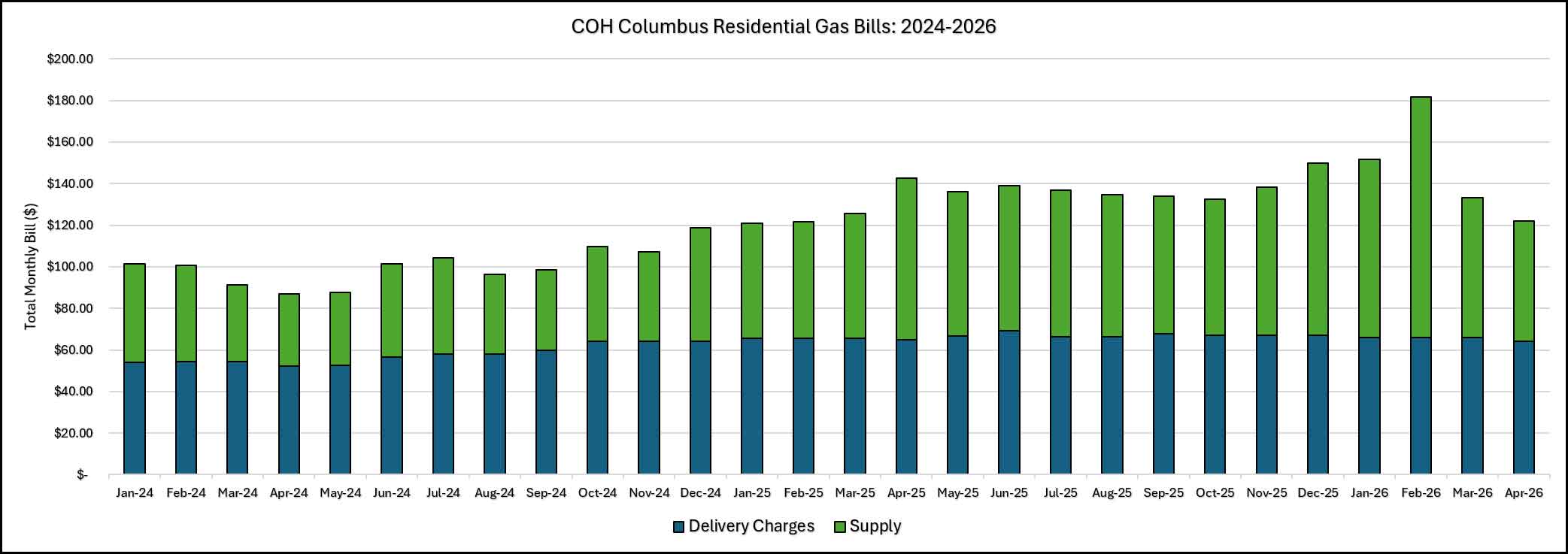
Takeaway: The largest changes in customer bills are driven by supply costs
Source: PUCO utility rate survey
Consumer Costs Chart Source: *Prices shown reflect U.S. national averages. For services where CPI does not publish dollar prices (rent, insurance, child care, telecommunications, food at home), representative national average monthly costs are shown for illustration only and are scaled using the applicable CPI-U category index. CPI measures price change, not price levels, and does not publish average prices for most services.
Inflation Comparison Over 20 Years
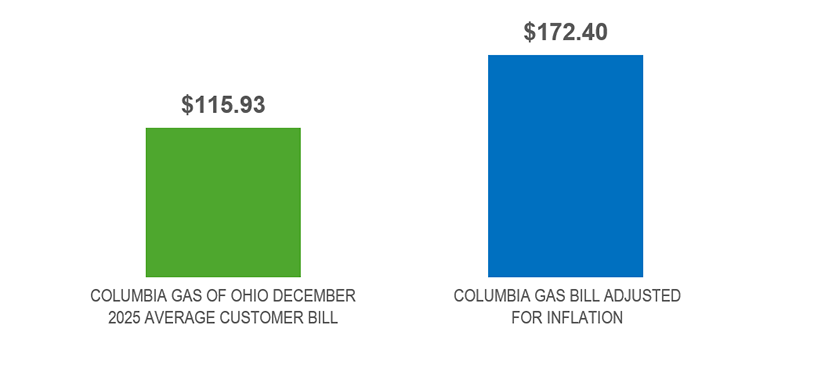
Takeaway: The Total Bill of the Average Residential customer using 64.4 Ccf per month is 33% lower in 2025 compared to 20 years ago when adjusted for inflation.
Inflation Chart Source: BLS